
SEYAR · Internal infrastructure · Ongoing development
AI-Powered Outbound & GTM Infrastructure
I built and configured the research, data and outbound workflows behind SEYAR’s customer acquisition. An internal operation, with human decisions throughout.
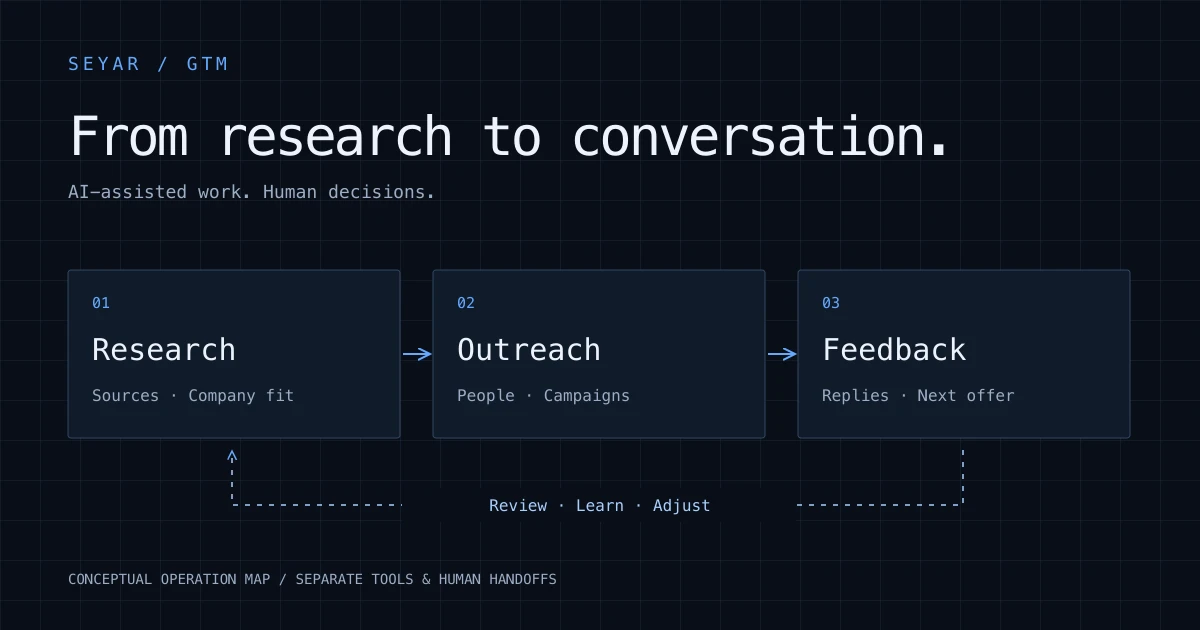
Overview
For my own company, SEYAR, I designed an operation that connects market research, AI-assisted data work, outbound email and sales follow-up. It supports testing different offers while I also build products. The work combines configured services, scripts and manual review; it is not a standalone sales platform.
The problem
A solo business needs to find relevant companies, identify decision-makers and test offers without spending all its time collecting lists. Fragmented sources create duplicate records and weak targeting. Mailbox administration, replies and follow-ups then compete with product development for the same person’s attention.
My role
I defined offer-specific ideal customer profiles, configured mailbox and campaign tools, and used ChatGPT and Codex to support research and data processing. I designed the company and contact stages separately, reviewed lead quality, prepared messages in Turkish and English, and handled commercial decisions, conversations and demos.
System architecture
Conceptual operating architecture. The steps use separate tools and human handoffs; this is not a fully integrated production pipeline.
- Market signals & data sources
- Company discovery
- AI-assisted qualification
- Contact enrichment
- Validation & deduplication
- Campaign preparation
- Outbound infrastructure
- Reply management
- CRM & sales feedback
Human review: offer selection, lead quality, campaign decisions, conversations and proposals. Sales feedback informs the next research cycle.
What I built / configured
An email infrastructure of approximately 300 mailboxes across three Microsoft tenants, plus a separate Google Workspace account. Campaign preparation includes warm-up, sender selection and controlled sending limits. Company research uses public directories, exhibitor lists, company sites and commercial signals. Python scripts and structured files support extraction, normalisation, source tracking and duplicate review.
Key technical and operational decisions
Start with an offer and the company it fits, then look for a relevant person. Keep company identity, source evidence and contact details separate. Use AI to help classify and prepare information, with human review before commercial action. Manage sender reputation, bounce signals and volume rather than treating mailbox count as sending capacity. Keep replies, demo requests and revenue as distinct outcomes.
Current implementation
Implemented: mailbox setup, campaign configuration and launch, offer-based segmentation, message variables, company-source records and scripted normalisation. Review and handoffs remain part of the process. In progress: broader source coverage, consistent qualification and contact enrichment. The exporter research track has two ICPs; its latest recorded snapshot was paused on 27 November 2026 before the contact stage. The target of 3,000 unique, relevant, send-ready contacts is not a completed result.
Early outcomes
A software-services campaign with roughly 1,200 leads was prepared and launched. This describes the campaign pool, not delivered emails or people reached. Demo requests and interest in conversations emerged. I used tailored demos and CRM follow-up to continue those conversations. Revenue, conversion rate, pipeline value and customer totals are not established by this case study.
Limitations and ongoing work
There is no single application orchestrating every step, and no autonomous sales agent making commercial decisions. Source coverage and identity checks are incomplete. Company suitability does not establish contact permission or email deliverability. Source terms, data quality and suppression / opt-out handling must be checked before use. A unified, end-to-end compliance or suppression layer has not been verified. No prospect records or private operational details are published here.
Technologies and tools
ChatGPT and Codex for research and data work; Python and CSV / JSON for processing and review; Microsoft email infrastructure and Google Workspace; Smartlead and PlusVibe for campaign work; ZoomInfo and GetLeads as research and enrichment providers; CRM for conversations and follow-up. These tools are used across the operation, not presented as one completed integration.
Next steps
Reconcile open company records before expanding the pool. When the exporter research resumes, measure contact yield separately from company count, then review enrichment, validation and opt-outs before campaign preparation. Use reply quality and sales conversations to refine offers. Automate repeated handoffs only once the underlying review rules are clear.
Have something in mind?
A project, a collaboration, or a conversation.